2 Daily 14 — Oct 8
2.1 Class Performance
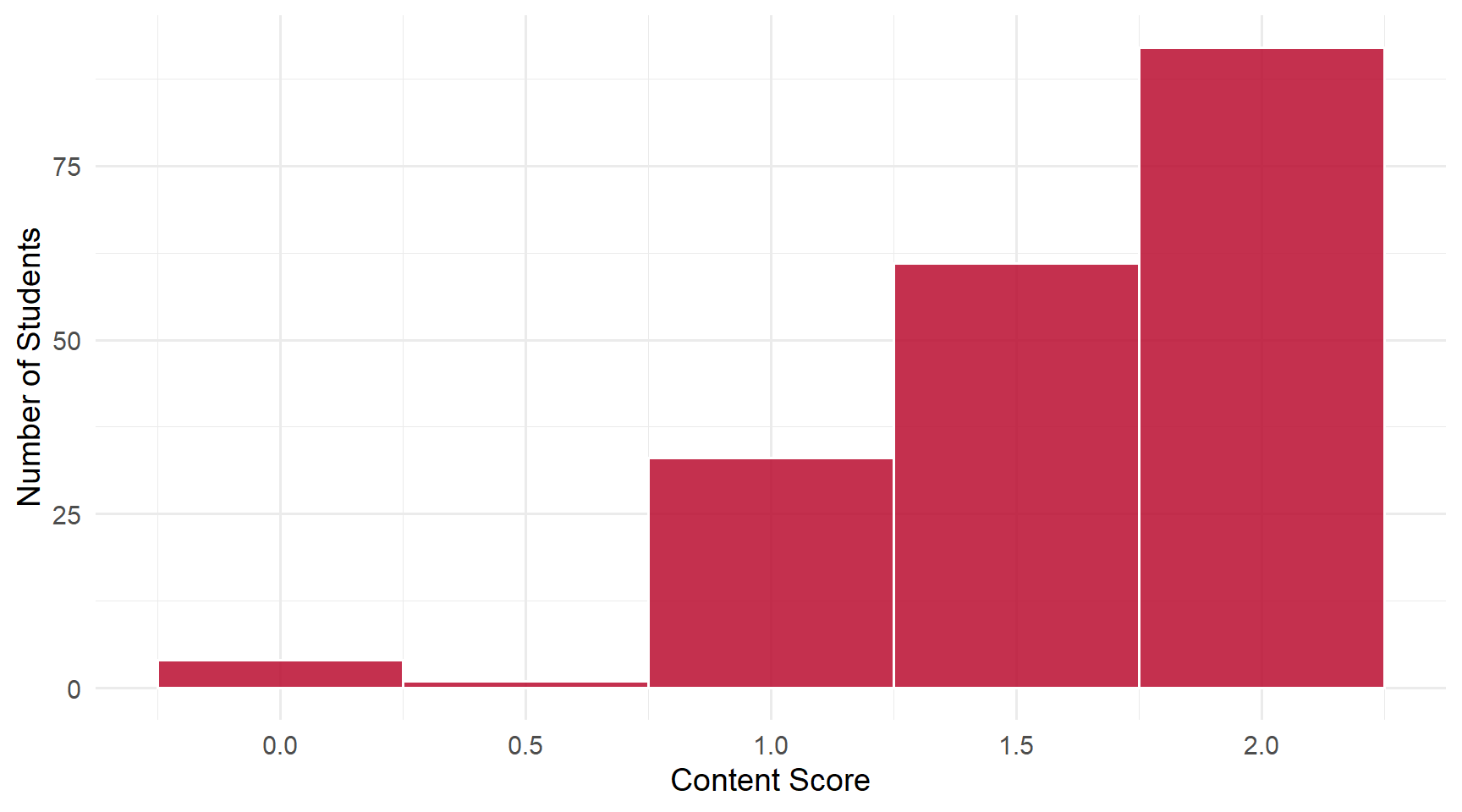
Students: 191 | Content mean: 1.62 / 2 | Median: 1.5 | SD: 0.45 | Mean daily score: 9.62 / 10
Content scores ranged from 0 to 2 out of 2. (Your daily score adds the 8-point attendance credit for submitting; each question is worth 1 of the remaining 2 points.)
NoteTwo questions, and no Daily 13 chapter
Only the first two questions on the slide were asked on Oct 8, so this daily is graded on two. Daily 13 (Oct 6) has no chapter: no questions were asked that day, and it was scored as full credit.
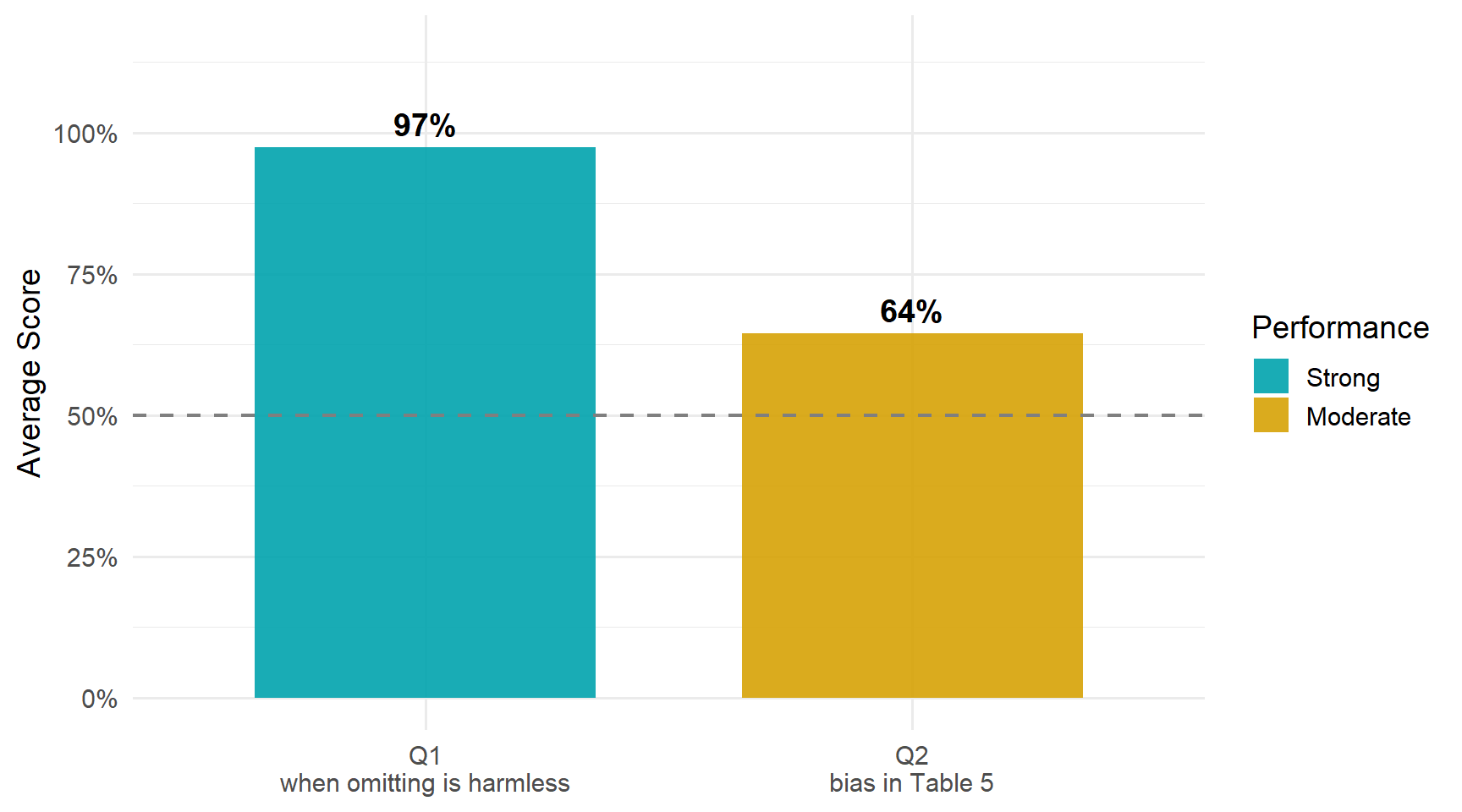
Q1 was close to universal: 97 percent of the class named both ways the bias can vanish. Q2 carried nearly all the lost credit, and its most common error is worth a careful look. Students knew both ingredients of the bias and still got its direction wrong.
2.2 Score Distribution
2.3 Performance by Question
ImportantThe pattern worth taking from this daily
The direction of omitted-variable bias is the product of two signs.
\[\text{bias} = \underbrace{\beta_{exper}}_{\text{effect on wages}} \times \underbrace{\delta_{exper,\,educ}}_{\text{relation to schooling}}\]
On Q2, about one student in seven wrote both signs correctly. They said experience is negatively correlated with schooling and positively with wages, and then called the bias upward. They had both ingredients and skipped the last step: a positive times a negative is negative, so the bias is downward.
Table 5 shows the same thing without any algebra. Adding exper raises the schooling coefficient from 0.052 to 0.093, so leaving it out had pushed the estimate down. When the table and your sign product disagree, one of them has been misread.
2.4 Questions
2.4.1 Q1: In \(y_i = \beta_0 + \beta_1 x_{1i} + \beta_2 x_{2i} + u_i\), if \(x_2\) is omitted, \(\hat\beta_1\) is biased unless \(\beta_2 =\) ___ or \(x_1\) and \(x_2\) are ___.
TipCorrect Answer
\(\beta_2 =\) 0, or \(x_1\) and \(x_2\) uncorrelated.
The omitted-variable bias formula says
\[E(\hat\beta_1) = \beta_1 + \beta_2\, \delta_{21},\]
where \(\delta_{21}\) is the slope from regressing \(x_2\) on \(x_1\). The bias is the product \(\beta_2\, \delta_{21}\), so it vanishes when either factor is zero: the omitted variable does not affect \(y\) (\(\beta_2 = 0\)), or it is unrelated to the included one (\(\delta_{21} = 0\)).
WarningCommon Errors
There were very few errors here, and they were scattered rather than systematic:
- A number from the regression output in place of the condition. The blanks ask when the bias disappears, not what a coefficient is.
- “Unbiased” in the second blank. That names the result, not the condition on \(x_1\) and \(x_2\).
- A look-alike word. “Uncorrected” is a different word from “uncorrelated”, not a misspelling of it.
“Zero” written out, “independent”, a slashed zero, and creative spellings of uncorrelated all cost nothing.
2.5 What the Class Did Well
The conditions for omitted-variable bias are secure. Nearly everyone named both ways it can vanish: the omitted variable has no effect on \(y\), or it is unrelated to the included \(x\).
Many of the Q2 misses were one step from right. The students who wrote “upward” with both signs correct had done the hard part, reading two relationships off the data. What remained was a multiplication.
2.6 What to Review
- Bias = effect × correlation. Write down both signs, then multiply them. Positive times negative is negative.
- Check the direction against the table. If adding a control raises a coefficient, leaving that control out had pushed the estimate down.
- Schooling and experience at a given age. Every year in school is a year not working, so the two move in opposite directions.
- “Biased ___” asks for a direction, not a magnitude.
NoteHow this was graded
Every paper was scored twice, independently, against the same published rubric, by graders who could not see each other’s scores or your name. The two passes agreed on more than 99% of all scores; the two disagreements were each reviewed a third time against the rubric and settled with a written reason. Submitting the daily earns 8 of 10 regardless of content.